Why most fleets do not have a fuel sensor
A capacitive fuel-level probe has to be cut into the tank, calibrated litre by litre, and kept clean. On many vehicles common in Nigerian fleets the tank shape makes calibration poor, and a probe that drifts produces exactly the false theft alarms that make managers stop trusting alerts. Reading fuel from the CAN bus needs a CAN adapter and a vehicle that broadcasts fuel data, which many do not. So most fleets that run trackers at all run them without any fuel input.
What a tracker measures well
A professional GPS tracker, wired to the vehicle’s permanent power and ignition, reports position, speed, ignition state, movement and a total odometer. Those are the signals fuel can be built on:
- Distance: the tracker’s total odometer (AVL 16) is counted in metres. On the vehicle FuelSense runs on, it agreed with the dashboard odometer to 0.03%.
- Engine-on time: ignition (AVL 239) and movement (AVL 240) together tell driving from idling, minute by minute.
- Speed: urban stop-start driving burns more per kilometre than steady highway cruising, and the speed trace shows which a trip was.
The model: distance plus idling
Fuel burned over a period is modelled as distance driven multiplied by the vehicle’s consumption rate, adjusted for stop-start versus highway driving, plus idling hours multiplied by the vehicle’s idle burn rate. Until a vehicle has its own history, FuelSense starts from a rate for its class:
| Vehicle class | Driving (L/100 km) | Idling (L/hour) |
|---|---|---|
| Sedan | 11 | 0.9 |
| SUV / pickup | 14.3 | 1.2 |
| Van / bus | 16 | 1.4 |
| Medium truck | 26 | 1.9 |
| Heavy truck | 40 | 2.8 |
| Motorcycle | 3 | 0.2 |
Making the rate the vehicle’s own
A class rate is only a starting point. Every receipt is a measurement: the tank cannot have been below empty before a fill or above its capacity after one, and any gauge reading a driver records narrows the range further. FuelSense learns each vehicle’s rate from the rate that keeps every receipt physically possible. On the RAV4 FuelSense runs on, the learned figure was 17.6 L/100 km in Abuja traffic, well above the brochure number. A manager can always enter a figure of their own, and it is never overridden.
What this approach can and cannot tell you
- It can price distance and idling in naira per vehicle, driver and day, and show where the money went.
- It can compare fuel bought on receipts against fuel the vehicle could plausibly have burned, and flag a gap.
- It cannot see fuel leave a tank. Siphoning while parked is invisible without a tank sensor; a gap between bought and burned is a question for a manager, not proof.
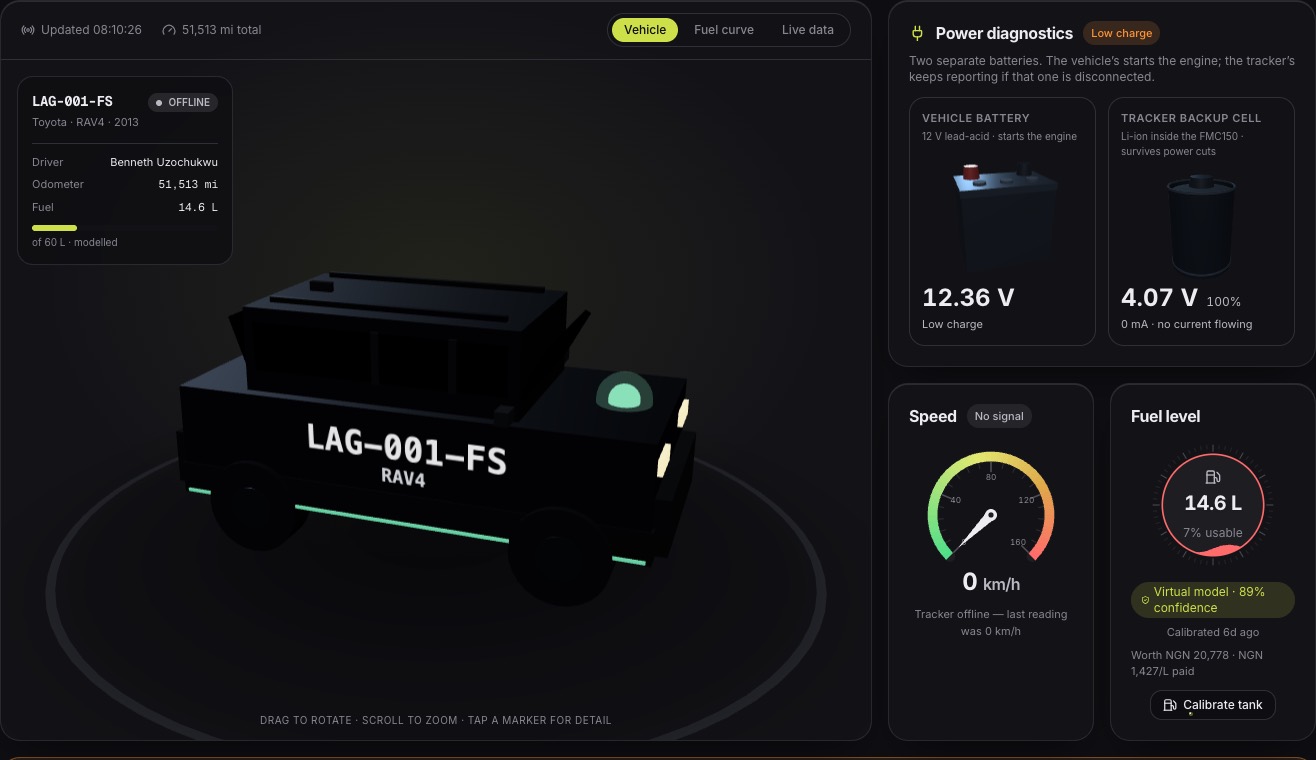
What it saves you
The value is not the litres figure on its own. It is what the figure lets you check every week without paying for probes or arguing about a gauge: whether the fuel bought matches the driving, how much was burned standing still, and which vehicles cost more per kilometre than their twins. Those three questions are where a fleet’s fuel money leaks.
One SUV, one month, priced from the model
- Driving: 1,000 km at 17.6 L/100 km
- 176 L
- Idling: 22 hours at 1.2 L/h
- 26.4 L
- Fuel the vehicle needed
- 202.4 L
- At NGN 1,430 a litre
- NGN 289,432
- Of which idling alone
- NGN 37,752
Rate and price are from the Abuja RAV4 FuelSense runs on (October 2026). Distance and idle hours are illustrative; FuelSense measures your own.
Compare that with the receipts for the same month. If the vehicle needed about 202 litres and receipts say 240, there are about 38 litres, roughly NGN 54,000, to ask about. If idling is a fifth of the bill, that is a conversation with the driver about air conditioning in the car park, not a theft case.
Getting started
- Fit one tracker per vehicle, wired to permanent power and ignition.
- Record the dashboard odometer once, so the tracker’s distance continues from the real total.
- Have drivers photograph every fuel receipt; the litres and price feed the rate and the naira figures.
- Review idling and the bought-versus-burned gap weekly, per vehicle.
Common questions
- How accurate is fuel estimated from GPS?
- Distance and idling time are measured accurately; the litres depend on the vehicle’s rate. Once a vehicle has a few receipts its learned rate reflects its real driving, and every figure is labelled as an estimate.
- Do I need a CAN bus adapter?
- No. The approach uses only what a standard tracker reports: odometer, ignition, movement and speed.
- Which tracker works?
- Any professional tracker that reports a total odometer and ignition state. FuelSense is built and tested on professional-grade trackers that do.