Idle burn rates by vehicle class
| Vehicle class | Idling (L/hour) | Cost per idle hour at NGN 1,430/L |
|---|---|---|
| Sedan | 0.9 | NGN 1,287 |
| SUV / pickup | 1.2 | NGN 1,716 |
| Van / bus | 1.4 | NGN 2,002 |
| Medium truck | 1.9 | NGN 2,717 |
| Heavy truck | 2.8 | NGN 4,004 |
A worked example
One SUV idles for an hour each working day, waiting with the air conditioning on. Over 22 working days that is 22 hours × 1.2 L/h = 26.4 litres, or about NGN 37,750 a month at NGN 1,430 a litre. Across a fleet of ten SUVs it is over NGN 377,000 a month, spent standing still.
What the tracker saw on a real vehicle
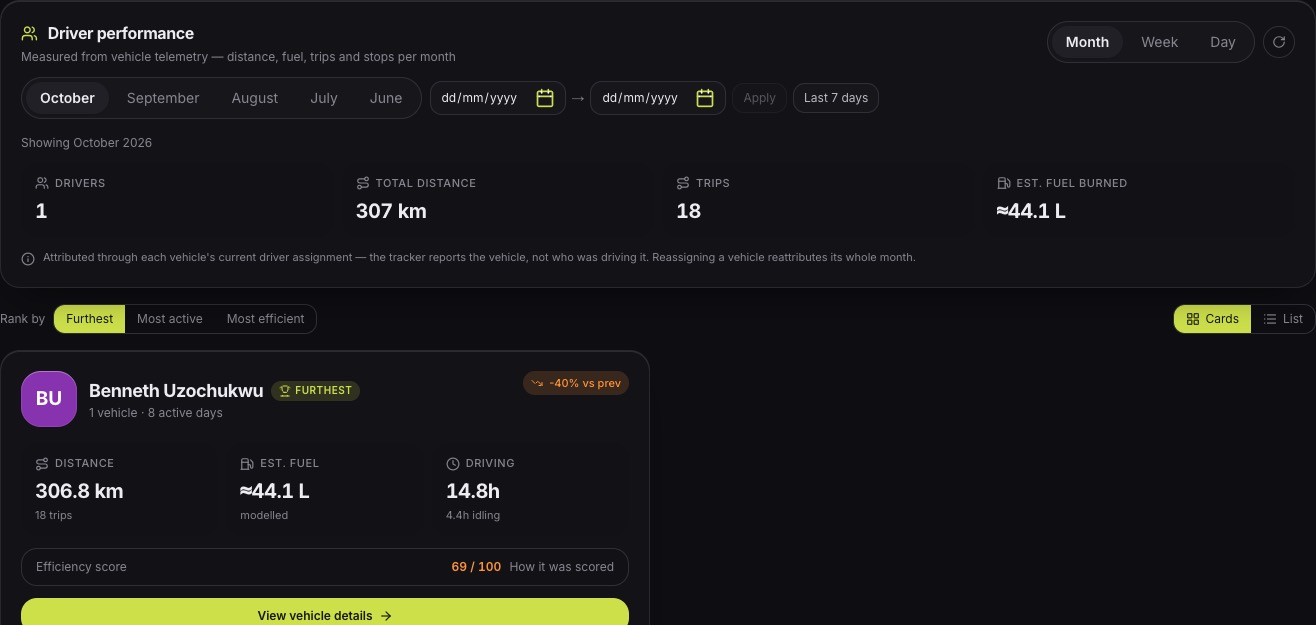
On the Abuja RAV4 FuelSense runs on, October 2026 to the 19th logged 14.8 hours of driving and 4.4 hours of idling over 8 active days: roughly an hour standing still with the engine on for every three and a half hours on the move. At the SUV idle rate of 1.2 litres an hour that is about 5.3 litres, or NGN 7,550, in under three weeks, from one car.
Why Nigerian fleets idle so much
- Air conditioning: drivers waiting in heat keep the engine on to run it.
- Traffic: Lagos and Abuja go-slows mean long engine-on stretches with no distance.
- Waiting for a principal or a delivery, often for hours at a time.
- Warm-up habits that run much longer than a modern engine needs.
How a tracker measures idling
Idling is ignition on with the vehicle stationary. A tracker reports both states, so every idle stretch can be timed to the minute, placed on the map and priced. FuelSense ignores GPS drift that makes a parked vehicle appear to creep, so a stationary engine is not mistaken for driving.
What cutting it saves
Ten SUVs halve their idling
- Idling before: 1 hour a working day each
- 264 L a month
- Idling after: 30 minutes a working day each
- 132 L a month
- Fuel saved, at NGN 1,430 a litre
- NGN 188,760 a month
- Saved in a year
- NGN 2.27 million
SUV idle rate 1.2 L/h and 22 working days a month. Halving is an assumed target; most fleets set theirs after a month of seeing the real figure.
Idling is the one fuel cost a driver controls completely, which is why it moves fastest once it is measured. Nobody has to be accused of anything: the number goes up on the screen, it is priced in naira, and it comes down.
Reducing it
- Show each driver their idle minutes and their cost in naira every week.
- Set a fleet threshold, such as ten minutes, and alert when it is exceeded.
- Find the places idling happens most (offices, depots, a client’s gate) and fix the wait, not just the driver.
Common questions
- Does idling use more fuel than restarting the engine?
- For a modern fuel-injected engine, restarting uses roughly as much fuel as a few seconds of idling, so switching off for any wait longer than about a minute saves fuel.
- Does air conditioning increase idle fuel burn?
- Yes. The compressor adds load, so a vehicle idling with AC on burns more than the same vehicle idling without it.
- Can I set my own idle rate per vehicle?
- Yes. FuelSense starts from the class rate and lets a manager set each vehicle’s own figure.