The idea in one sentence
Think of every fuel receipt as the bill for the driving the vehicle did since its last fill. If you know how far it drove in that time, you can check whether the bill makes sense.
The method, step by step
- Take a receipt, say 13.99 litres bought on 12 October.
- Find the previous receipt for the same vehicle, here 6 October.
- Read how far the tracker says the vehicle drove between those two fills: 127.6 km.
- Divide the litres by the distance and multiply by 100: 13.99 ÷ 127.6 × 100 = 11.0 litres per 100 km.
- Do the same for the next receipt, and the next. Then look at the figure across several fills together, because that is where the truth is.
You do not have to do this by hand. FuelSense puts the distance since the previous fill beside every receipt as soon as it is filed, so the arithmetic is already done when you open the list.
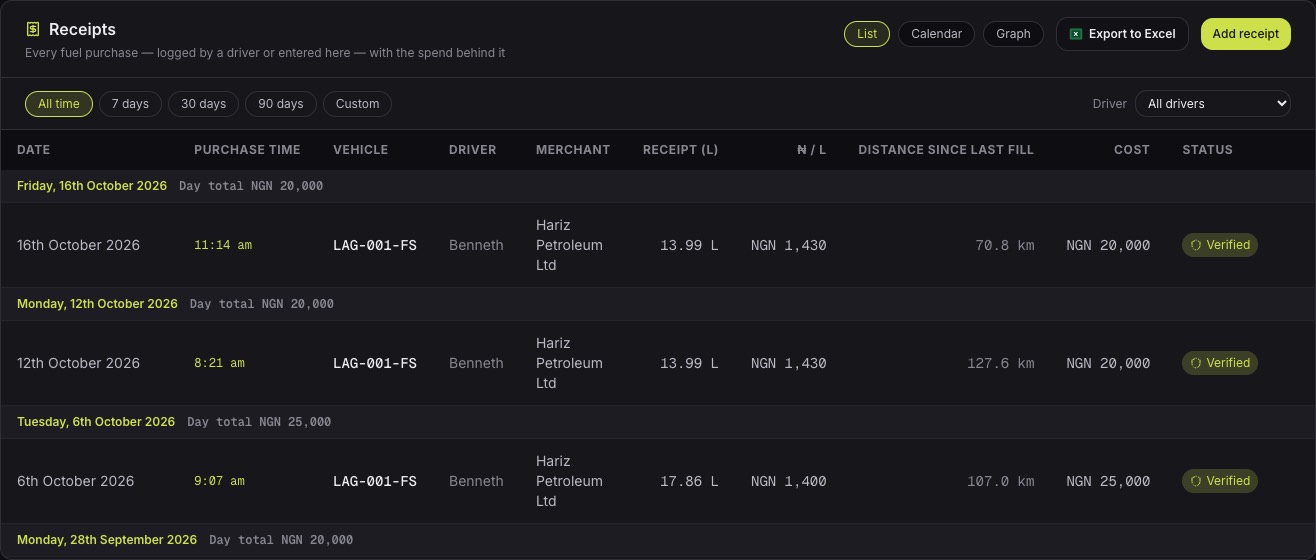
The numbers behind the picture
| Fill | Litres | Distance since previous fill | Naira |
|---|---|---|---|
| 16 Oct | 13.99 | 70.8 km | NGN 20,000 |
| 12 Oct | 13.99 | 127.6 km | NGN 20,000 |
| 6 Oct | 17.86 | 107.0 km | NGN 25,000 |
Why did 12 October work out at 11.0 and 16 October at 19.8, on the same car? Because this driver buys a fixed amount of naira each time rather than filling to the top. Some fills leave the tank fuller than others, so the next interval borrows or lends fuel. Neither number is wrong; each is just one slice. Put the two together and the swing cancels out: 27.98 litres over 198.4 km is 14.1 litres per 100 km.
What a “normal” figure is
The figure to compare against is the vehicle’s own, not the brochure. FuelSense learns it from the vehicle’s receipts: the one rate that makes every fill physically possible for the tank. For the RAV4 above, in Abuja traffic, that came to 17.6 litres per 100 km. An SUV whose fills keep coming out at 25 or 30 on the same routes is buying fuel it is not burning.
Why the tracker odometer, not GPS points
Adding up straight lines between GPS positions cuts every corner and drops slow crawling, so it reads short. On the intervals above, the GPS sum was 1–3 km below the odometer each time. The tracker’s odometer counts continuously and matches the dashboard.
Receipts worth a second look
- More litres than the tank could hold: a 60-litre tank cannot take 70.
- A fill time when the trip history shows the vehicle somewhere else, or not stopped at all.
- A run of fills whose rate stays far above the vehicle’s own figure.
These are checks for a manager to make with the trips and receipts side by side. FuelSense credits every receipt as filed and does not raise alerts on receipts by itself; it gives you the distance and the history to ask the question.
What reconciling is worth
The vehicle in this guide spent NGN 284,378 on fuel between 6 August and 16 October 2026, about NGN 120,000 a month. Most fleets never compare that spend with distance, so a gap of a few percent goes unseen for years.
A ten-vehicle fleet, one month
- Fuel bought, at about NGN 120,000 per vehicle
- NGN 1,200,000
- Share not backed by distance (assumed)
- 5%
- Money that reconciling brings into view
- NGN 60,000
- Over a year
- NGN 720,000
Spend per vehicle is from the receipts above. The 5% gap is an assumption for illustration; your own receipts against your own distance give the real figure.
Common questions
- Do drivers have to fill to full every time?
- No. Partial fills work as long as every fill has a receipt; the rate is learned across many intervals.
- What if a driver forgets a receipt?
- The interval then contains fuel with no record, which inflates the next interval. Missing receipts are themselves worth following up.
- Can drivers file receipts from their phone?
- Yes. In FuelSense drivers photograph the receipt and the litres, price and station are read from it.