What a tracker sends by default
With its stock configuration, the tracker FuelSense runs on sends fifteen I/O elements alongside each GPS record:
| AVL ID | Element | Useful for |
|---|---|---|
| 16 | Total odometer (metres) | Distance, the basis of every fuel figure |
| 239 | Ignition | Engine-on time, trip starts and ends |
| 240 | Movement | Driving versus idling |
| 24 | Speed | Stop-start versus highway driving |
| 69 | GNSS status | Whether a position can be trusted |
| 181 / 182 | PDOP / HDOP | Rejecting poor fixes |
| 199 | Trip odometer | Per-trip distance |
| 21 | GSM signal | Coverage diagnosis |
| 68 | Battery current | Device power diagnosis |
| 200 | Sleep mode | Telling sleep apart from loss of power |
| 241 | GSM operator | Which network the device is on |
| 449 | Ignition-on counter | Engine hours cross-check |
| 12 / 13 | Fuel used GPS / fuel rate GPS | Not recommended (see below) |
Why not use AVL 12 “fuel used”?
Elements 12 and 13 are calculated inside the tracker from GPS speed and generic constants set in the tracker’s configuration tool. Unless those constants are set for the specific vehicle, the result can be far off: on the FuelSense test vehicle AVL 12 counted 1.3 litres over 117 km. A model built on the odometer and the vehicle’s own receipts is far more accurate.
What it cannot report without extra hardware
- Real tank level: needs a fuel-level sensor or CAN data.
- Engine RPM, coolant temperature, CAN fuel used: need a CAN adapter and a vehicle that broadcasts them.
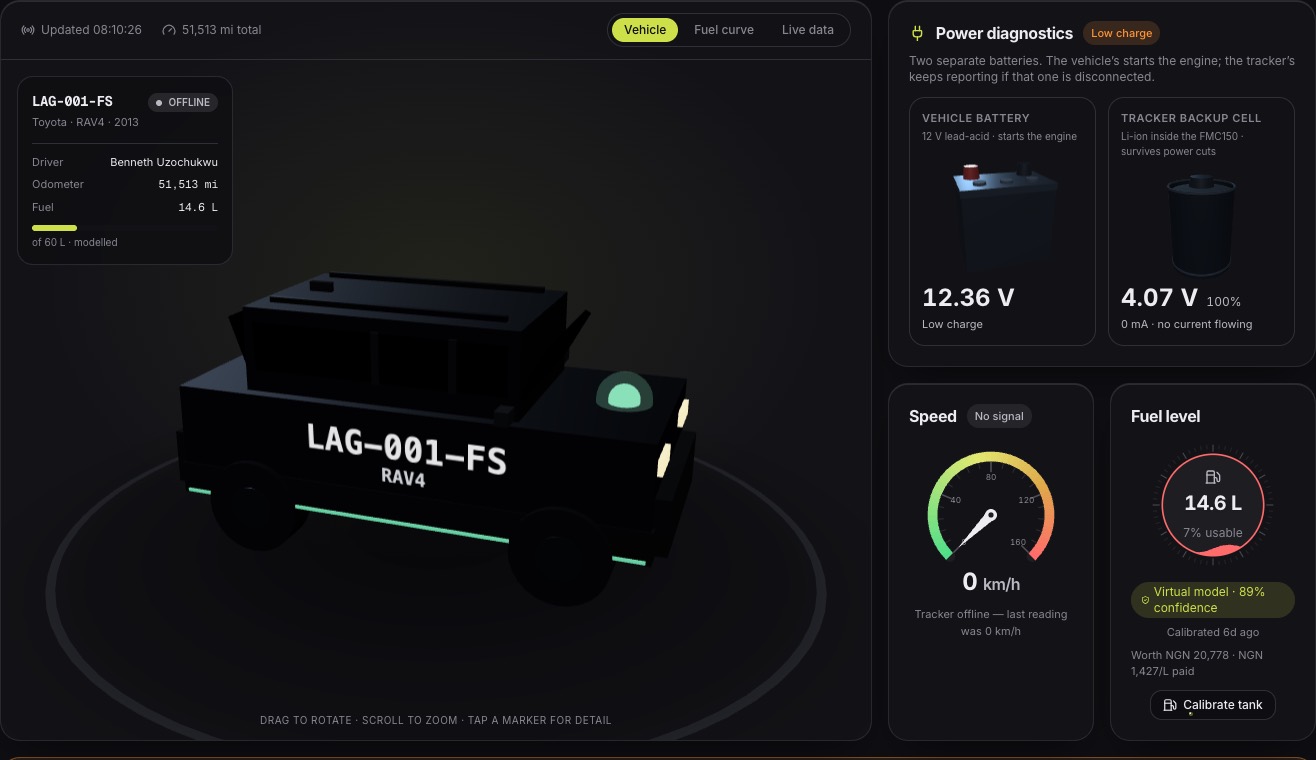
- External supply voltage (AVL 66) and backup battery voltage (AVL 67) are not sent by default and must be enabled in the tracker’s configuration.
Why these elements are worth money
A tracker that only reports position tells you where a vehicle is. The odometer, ignition and movement elements are what turn it into a fuel and cost tool: distance prices every litre the vehicle should have needed, ignition and movement separate paid driving from idling, and the voltages warn you before a flat battery strands a vehicle and a driver for a morning.
Installation that makes the data trustworthy
- Wire to permanent 12 V power and to the ignition line, so ignition is reported from the vehicle rather than inferred.
- Mount with a clear view of the sky through glass, away from metal and heated windscreen film.
- Record the dashboard odometer at install so the tracker’s distance continues from the real total.
- Enable external voltage (AVL 66) if you want tamper and power-loss alerts based on voltage.
Common questions
- Does the tracker have a SIM?
- It takes a standard SIM. On the FuelSense test unit it reports operator code 62130, which is MTN Nigeria.
- Can the tracker cut the engine?
- With a relay wired to its digital output it can immobilise a vehicle remotely. It should only be engaged when the vehicle is stopped.
- Is the tracker’s odometer accurate?
- On the FuelSense test vehicle it agreed with the dashboard odometer to within 0.03%.