The common forms of fleet fuel loss
- Receipt padding: a receipt for more litres or naira than went into the vehicle.
- Private use: the vehicle is driven for personal errands, evenings or weekends.
- Selling from the tank or jerrycans: fuel is bought on the company account and resold.
- Siphoning while parked: fuel is drawn from the tank with the vehicle stationary.
- Idling: not theft, but the largest controllable loss in Lagos and Abuja traffic.
The fill-to-fill test
Every receipt closes an interval. Between this fill and the previous one the tracker knows exactly how far the vehicle went and how long the engine idled. Divide the litres bought by that distance and you have a real consumption figure for the interval. If a vehicle that normally burns 14 litres per 100 km shows 25 over several fills, more fuel is being bought than the vehicle is using.
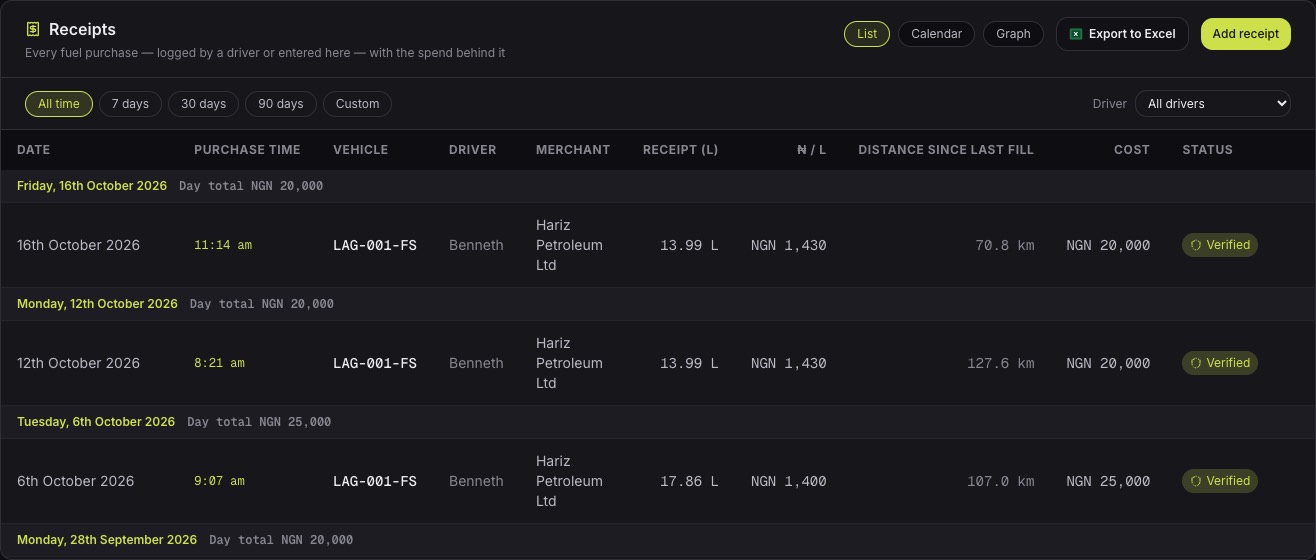
Distance is the reliable half of the equation. FuelSense uses the tracker’s own odometer for it, which on its test vehicle agreed with the dashboard to 0.03%. A typical recent interval on that vehicle: 13.99 litres bought, 70.8 km driven since the previous fill.
Patterns worth a closer look
- A rising litres-per-100 km figure over several fills, on the same vehicle and route.
- A receipt where the vehicle was not at, or never stopped at, a fuel station at that time.
- Fills that would not fit the tank: more litres than the tank holds above its last known level.
- Movement outside working hours, or trips that leave the expected route.
What GPS cannot prove
No GPS tracker can see fuel leaving a tank. If fuel is siphoned from a parked vehicle, distance and idling look normal and only a fuel-level sensor would show the drop. Likewise, a gap between bought and burned is evidence that something does not add up, not proof of who did what. The useful response is to ask the driver, with the trips and receipts in front of both of you.
What it is worth catching
Fuel loss rarely arrives as one big theft. It is a few litres on many receipts, a private errand most evenings, a car left running in a car park. Each is small enough to ignore and together they are a line on the profit and loss. The figures below are illustrative; the point is how quickly small leaks add up across a fleet.
A ten-vehicle fleet, one month
- Receipts padded by 2 litres, twice a week per vehicle
- 160 L
- Private trips: 60 km a week per vehicle at 14 L/100 km
- 336 L
- Fuel at NGN 1,430 a litre
- NGN 709,280
- Lost in a year if nobody checks
- NGN 8.5 million
Every quantity here is an assumption for illustration, not a measured average. A fleet with one tracker per vehicle and every receipt filed sees its own figures instead.
FuelSense does not catch anyone. It puts the distance behind every receipt, times every trip from the ignition, logs every visit to the fuel stations you mark, and replays any day on the map, so the conversation with a driver starts from the same facts on both sides.
Setting it up in practice
- Require a photographed receipt for every fill; reject fills without one.
- Mark the fuel stations your fleet uses as zones so station visits are logged.
- Review the fill-to-fill rate per vehicle each week, not single fills, which are noisy.
- Price idling in naira and share it with drivers; it is usually the bigger number.
Common questions
- Can a GPS tracker detect fuel siphoning?
- Not directly. Siphoning from a parked vehicle changes nothing a GPS tracker measures. It needs a fuel-level sensor in the tank.
- Is one bad fill enough to suspect theft?
- No. A partial fill or a long idle can make a single interval look wrong. Look for a consistent pattern across several fills.
- Does FuelSense accuse drivers automatically?
- No. It shows the gap and the trips behind it so a manager can ask; it never labels a driver a thief.